

Research & Development
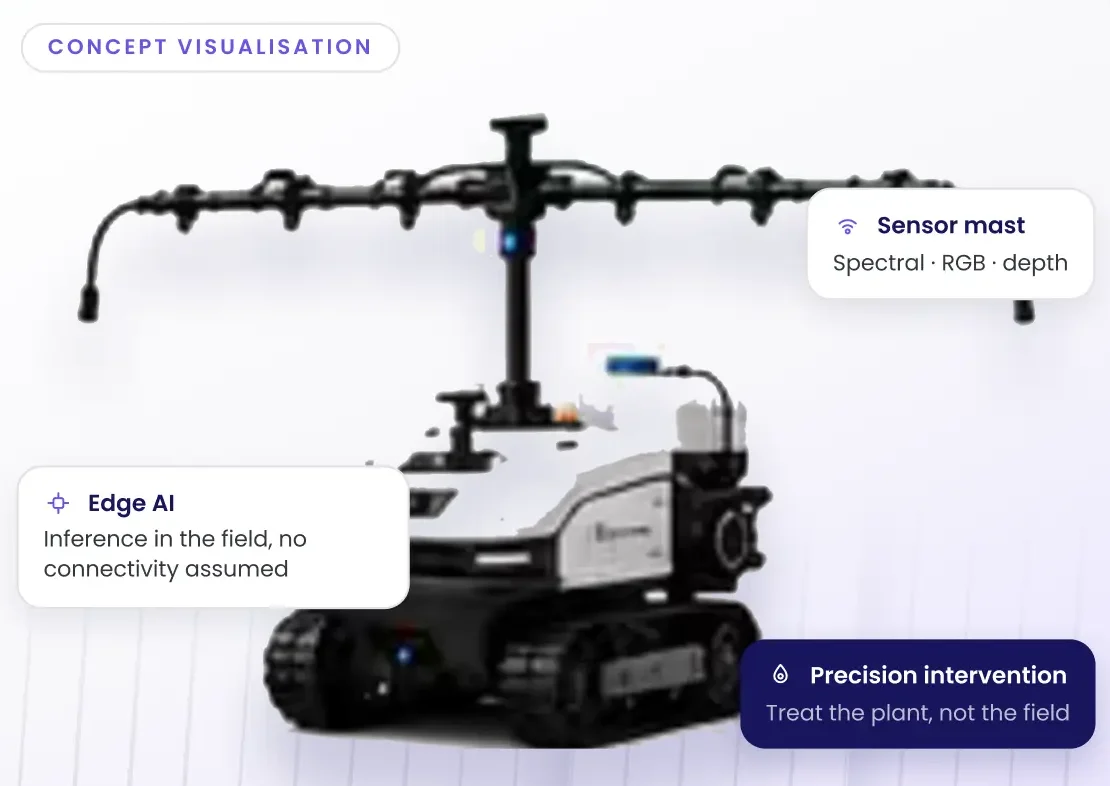

Robotics
Autonomous platforms in unstructured ground

Sensing
Plant-level spectral, RGB and depth capture

Edge AI
Inference without reliable rural connectivity

Precision intervention
Controlled dosing at zone or plant scale
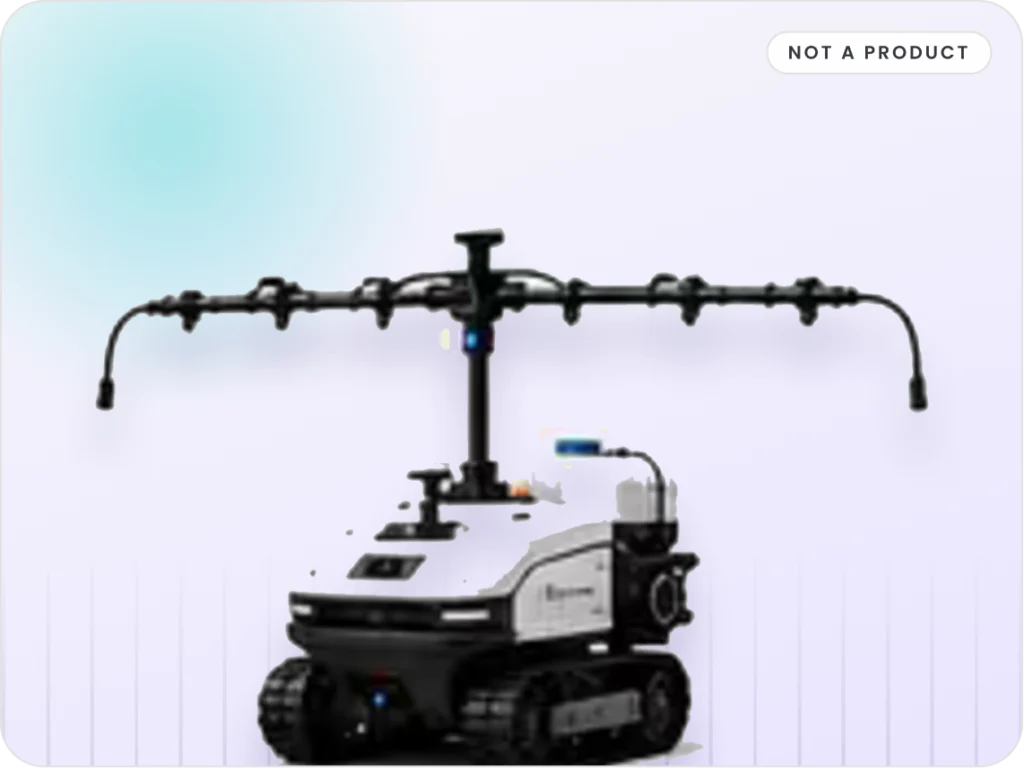

Concept under research

Autonomous base
Tracked, narrow-gauge, sized to travel between established rows.

Sensor mast
Adjustable height so capture geometry holds as the canopy develops.

Spectral, RGB and depth sensing
Three views of the same plant: colour, stress signature and structure.

Edge AI compute
Diagnosis on the machine, so a decision does not wait for a signal.

Precision intervention module
Interchangeable head — the platform's first modular pathway.

Autonomous mobility
Navigation, path planning and obstacle handling on soft, uneven ground.

Multimodal sensing
Fusing spectral, RGB and depth streams into one plant-level record.

Edge AI
Models small and fast enough to run on the machine, in the field.

Precision intervention
Controllable geometry, flow and dose — measured, repeatable application.

Field intelligence
A season-long record of what was seen, decided and applied, zone by zone.

Sense
Multimodal capture at plant level — spectral, RGB and depth, geo- referenced row by row.

Diagnose
On-board models look for early stress signatures and separate crop from weed, plant by plant.

Decide
Treat, dose, irrigate or leave alone. Agronomist rules stay in the loop and remain auditable.

Act
A targeted physical intervention at the zone or plant, then measured again on the next pass.

Observe
Capture field data across a season to learn what is actually visible.

Understand
Label, model and test whether early stress can be separated from noise.

Decide
Turn diagnosis into agronomist-approved, auditable decision rules.

Intervene
Trial precision application through the first crop-care module.

Validate
Independent measurement against conventional practice on the same ground.

Scale
Only if the evidence supports it: more modules, more crops, more sites.

Input efficiency
Applying water, nutrient and treatment where a measurement says it is needed, rather than uniformly.

Earlier detection
Catching crop stress sooner gives a grower more options and smaller interventions.

Repeatable field work
Consistent, recorded passes through the crop, in a sector under real labour pressure.

Universities
Plant science, robotics and machine-learning research capacity.

Growers
Real field conditions, operating constraints and honest priorities.

Agronomists
The decision rules any autonomous system has to respect.

AI researchers
Model design and validation for constrained edge hardware.

Engineering partners
Mechanical, hydraulic and manufacturing expertise.